| Assets | % | Liabilities & Equity | % | ||
|---|---|---|---|---|---|
| Foreign Reserves | 6.5 | Currency | 88.6 | ||
| Securities | 89.1 | Reserves (Commercial Banks) | 1.2 | ||
| Loans | 2.8 | Government Account | 0.6 | ||
| Other Assets | 1.6 | Other Liabilities | 5.5 | ||
| – | – | Equity | 4.1 | ||
| Total | 100.0 | Total | 100.0 |
Week 05
Instituto Universitário de Lisboa (ISCTE-IUL)
October 19, 2026
The Fed board meeting (also know an the FOMC - Federal Open Market Committee)
The European Central Bank (ECB) board meeting
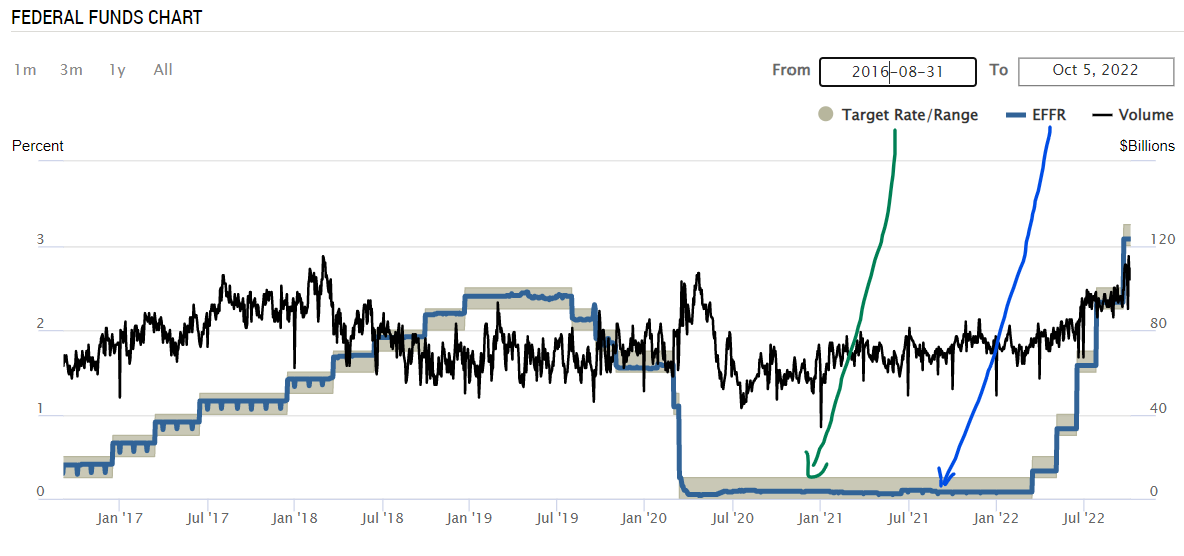
“The Federal Reserve sets two overnight interest rates: the interest rate paid on banks’ reserve balances and the rate on our reverse repurchase agreements. We use these two administered rates to keep a market–determined rate, the federal funds rate, within a target range set by the FOMC.” —Jerome Powell, Chair of the Federal Reserve, (2019) here
Last week, we saw the central bank will change the real interest rate \((r)\) as a response to changes in inflation \((\pi)\) or in the natural real interest rate \((\bar{r})\): \[r=\overline{r}+\lambda \pi \tag{MP curve}\]
And the Fisher equation says that the Fed must implement a change in the Fed Funds rate \((i)\) such that \(r\) will change, given that \(\pi\) is constant in the short-term: \[i = r+\pi \tag{Fisher equation}\]
Federal Reserve Balance Sheet: 31 December 2007
| Assets | % | Liabilities & Equity | % | ||
|---|---|---|---|---|---|
| Foreign Reserves | 6.5 | Currency | 88.6 | ||
| Securities | 89.1 | Reserves (Commercial Banks) | 1.2 | ||
| Loans | 2.8 | Government Account | 0.6 | ||
| Other Assets | 1.6 | Other Liabilities | 5.5 | ||
| – | – | Equity | 4.1 | ||
| Total | 100.0 | Total | 100.0 |
Federal Reserve Balance Sheet: 31 March 2025
| Assets | % | Liabilities & Equity | % | ||
|---|---|---|---|---|---|
| Foreign Reserves | 0.3 | Currency | 34.5 | ||
| Securities | 95.4 | Reserves (Commercial Banks) | 51.2 | ||
| Loans | 0.1 | Government Account | 4.7 | ||
| Other Assets | 4.2 | Repos | 9.3 | ||
| – | – | Equity | 0.3 | ||
| Total | 100.0 | Total | 100.0 |
The Federal Reserve Bank of New York purchases $1 billion in U.S. Treasury bonds from a commercial bank (page 459)
| Assets | $ Billions | Liabilities | $ Billions |
|---|---|---|---|
| Securities | \(+1\) | Reserves | \(+1\) |
| Total assets | \(+1\) | Total liabilities | \(+1\) |
| Assets | $ Billions | Liabilities | $ Billions |
|---|---|---|---|
| Reserves | \(+1\) | ||
| Securities | \(-1\) | ||
| Total assets | \(0\) | Total liabilities | \(0\) |
The U.S. Treasury instructs the Federal Reserve to buy $1 billion worth of bonds denominated in euros (page 459)
| Assets | $ Billions | Liabilities | $ Billions |
|---|---|---|---|
| Foreign Exchange Reserves | \(+1\) | Reserves | \(+1\) |
| Total assets | \(+1\) | Total liabilities | \(+1\) |
| Assets | $ Billions | Liabilities | $ Billions |
|---|---|---|---|
| Reserves | \(+1\) | ||
| Foreign Exchange Reserves | \(-1\) | ||
| Total assets | \(0\) | Total liabilities | \(0\) |
Commercial banks borrow \(100\) million dollars from the Fed, through the “discount window”, providing collateral.1 (page 461)
| Assets | $ Millions | Liabilities | $ Millions |
|---|---|---|---|
| Discount loans | \(+100\) | Reserves | \(+100\) |
| Total assets | \(+100\) | Total liabilities | \(+100\) |
| Assets | $ Millions | Liabilities | $ Millions |
|---|---|---|---|
| Reserves | \(+100\) | Discount loans | \(+100\) |
| Total assets | \(+100\) | Total liabilities | \(+100\) |
Jane withdraws $100 from her checking account (page 462)
| Assets | $ Millions | Liabilities | $ Millions |
|---|---|---|---|
| Currency | \(+100\) | ||
| Deposits | \(-100\) | ||
| Total assets | \(0\) | Total liabilities | \(0\) |
Recall that Jane changed money in her deposit account (Deposits) into money in her pockets (Currency)
| Assets | $ Millions | Liabilities | $ Millions |
|---|---|---|---|
| Currency | \(+100\) | ||
| Reserves | \(-100\) | ||
| Total assets | \(0\) | Total liabilities | \(0\) |
| Assets | $ Millions | Liabilities | $ Millions |
|---|---|---|---|
| Reserves | \(-100\) | Deposits | \(-100\) |
| Total assets | \(-100\) | Total liabilities | \(-100\) |
| Term | Acronym | ||
|---|---|---|---|
| Federal Funds Rate | FFR | ||
| Federal Open Market Committee | FOMC | ||
| Interest on Excess Reserves | IOER | ||
| Interest on Reserve Balances | IORB | ||
| Overnight Reverse Repurchase Agreement | ON RRP | ||
The Fed sets the quantity of reserves supplied \((R^s)\)
The Fed sets the two critical rates: IORB and ON RRP
The Fed reduces the supply of Reserves.
The Fed increases both rates: IORB and ON RRP.
The Fed navigates with the tools close to perfection.
The ECB has a similar monetary policy structure. The names change a little bit, but the essence is the same.
— Not covered in this course —
When the Fed Funds Rate comes down to zero, and the economy still needs some support from monetary policy, the Fed has two options:
The unconventional monetary policy tools are basically three:
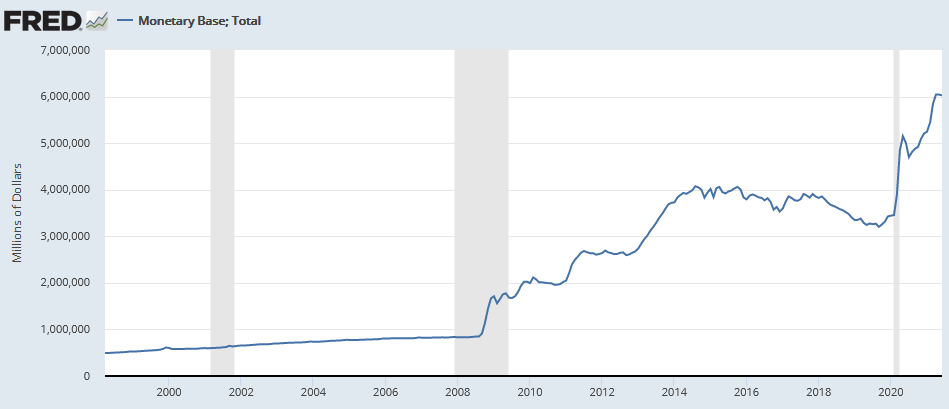
QE consists basically of one decision by the central bank: buying vast quantities of bonds and expanding its balance sheet by a magnitude of 3 or 4 in a few years.
Why is it different from “conventional” monetary policy?
Because the bonds bought under QE are:
In contrast to QE, which increases the size of the central banks balance sheet by all sorts of bonds, targeted asset purchases (TAP) shift the composition of the balance sheet toward selected assets in order to boost their relative price, reducing their yields, and stimulate economic activity.
A recent example of this type of tool has become known as the “Operation Twist”. The Fed bought longer-term Treasuries and Mortgage-Backed Securities. It simultaneously sold some of the short-term assets it already held to ease the economy by bringing down long-term interest rates.
In 2008: MB=0.8 trillion dollars; in 2021: MB = 6 trillion US dollars
For a general overview of the evolution of the Fed’s monetary policy read the Fed’s blog:
For the balance sheet of the central bank read:
For the changes in the Fed’s balance sheet read:
For the monetary policy tools read:
“Unconventional Policy Tools”. Not covered in this course